
Blog · September 18, 2026
Introducing Geom: AI for production-scale architecture
We're building the intelligent automation layer for the architectural workflows that turn designs into homes.
Shanna Tellerman · Founder & CEO
Every home starts as a set of ideas.
Before those ideas become foundations, framing, and finished spaces, they must pass through an enormous amount of architectural production work: plans are reviewed, annotations and details are added, elevations are rendered, lots are configured, construction documents are assembled, and changes are checked across hundreds of sheets.
This work is essential.
It is also far more manual than most people realize.
Many of the country's largest homebuilders still depend on tools and workflows developed decades ago. Their architecture teams routinely move information between disconnected files, repeat the same drafting operations across communities, and manually inspect plan sets for inconsistencies.
The people doing this work are highly skilled. But too much of their time is spent on tasks that are repetitive, labor-intensive, and vulnerable to human error.
We started Geom because we believe these teams deserve the benefits of modern AI, without replacing the tools, files, and workflows they already rely on.
Today, we're introducing Geom, an AI platform for production-scale architecture. We are emerging from stealth alongside more than half a dozen of the nation's largest production homebuilders as collaboration partners, including Pulte, Century Communities, Meritage, and True Homes.
Our mission is simple:
Automate the repetitive work required to turn architectural designs into buildable spaces, starting with homes.
Architecture has a production problem
Production homebuilders operate at a scale that is difficult to appreciate from the outside.
A single plan can have multiple elevations, structural configurations, jurisdictional requirements, and buyer-selected options. That plan may then be adapted across hundreds of communities and combined into thousands of unique construction-document packages.
A small code change can ripple across an entire plan library.
A missed inconsistency can reach the field, where it becomes much more expensive to resolve.
Over time, builders have created sophisticated standards and operating processes to manage this complexity. But the underlying tools have not kept pace. Much of the industry is still being asked to do more with software and workflows that are fundamentally unchanged from a generation ago.
Building information modeling demonstrated the value of connected design information. But in production homebuilding, the cost and complexity of converting, configuring, and maintaining BIM systems have limited adoption. Builders often have years or decades of valuable work embedded in existing CAD files, plan sets, standards, and processes.
Asking them to discard all of that is not a realistic path forward.
The industry does not need another system migration.
It needs intelligence that can work with the systems it already has.
Plans are more than drawings
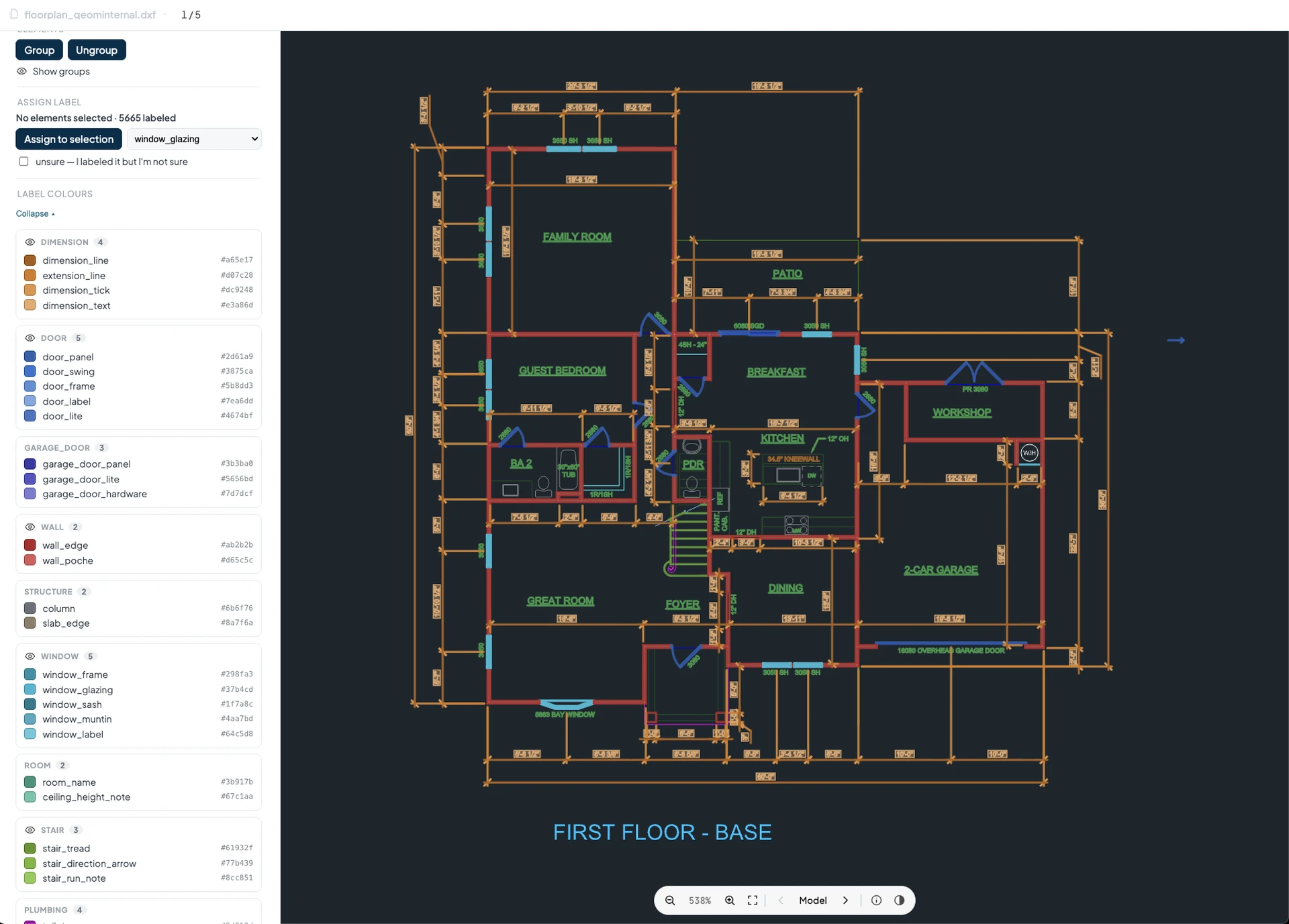
To a person, a floor plan is not simply a collection of lines.
We understand that a particular group of lines represents a wall. We recognize that a door sits within that wall, that a dimension refers to a specific distance, and that a change in one part of a plan may need to appear in several other drawings, notes and tables.
Traditional software generally does not understand those relationships.
Geom does.
Our platform creates a semantic understanding of the elements and relationships within a builder's existing plans and plan sets. It transforms static geometry into structured, connected information that AI can interpret and purpose-built tools can act on reliably.
That understanding makes it possible to automate work while preserving the builder's existing tools, file formats, standards, and approval processes.
Builders do not have to start over.
Geom meets them where they are.
From manual workflows to intelligent automation
We are initially focused on some of the most repetitive and time-consuming workflows in production architecture:
- Quality-control review
- Option solving
- Plan mirroring
- Elevation rendering
- Plot plan development
- Construction-document preparation
These workflows are different, but they share a common foundation. Each requires an understanding of what architectural elements mean, how they relate to one another, often across multiple files, and how a builder's standards should be applied.
Once that foundation exists, work that previously took days or weeks can happen in minutes.
In one project, Geom reduced plan mirroring from weeks to minutes while lowering the cost of the workflow by 73%.
In another, Geom reorganized master sheet sets into construction-document sets for more than 300 plans in 20 minutes. The previous process required two to three days of manual work and was vulnerable to errors.
These are not demonstrations built around artificial examples. They are real production workflows involving the files, standards, and constraints that builders work with every day.
And we are still at the beginning.
Automate the repetition. Preserve the judgment.
Architecture is not just geometry.
It requires judgment, context, creativity, and an understanding of how people will live in and build the spaces being designed. Especially in an affordability-constrained and continuously evolving market. Those are not the parts of the job we want to remove.
We want to give architectural teams more time for them.
For too long, the industry has been asked to do more with the same 40-year-old tools. We are building Geom to fit into the workflows builders already use and automate the tedious work, so their teams can focus on the designs and decisions that deserve their expertise and judgment.
This distinction matters.
The goal is not automation for its own sake. The goal is to help teams produce better work, more efficient and customer-centric designs, iterate more quickly, catch problems earlier, and spend less time repeating tasks a machine can perform.
AI should amplify the expertise of architects and builders.
Built with builders, not just for them
Production homebuilding is a deeply specialized industry. Every builder has its own architectural standards, plan libraries, terminology, approval processes, and regional requirements.
That means the platform cannot be developed in isolation.
Geom is being built in close collaboration with architecture and operations teams inside leading homebuilders. We begin with real workflows, measure the current process, and work alongside those teams to design automation that can perform reliably in production.
“Geom is helping streamline some of the most labor-intensive and time-consuming processes in residential architecture through the use of AI,” said Kieran Hardesty, VP of National Architecture at Century Communities. “Century Communities is excited to collaborate with their team as they work to improve how builders manage plans, reduce manual effort, and produce construction documents more efficiently.”
Our design partners are doing more than testing software. They are helping define what an intelligent production architecture platform should become.
Their standards, however, remain theirs.
Geom is being built for enterprise use from the start. Builders' proprietary plans, data, and standards are safeguarded, remain under their control, and are never used for cross-company model training.
Trust is not a feature that can be added later. It is part of the architecture of the platform.
Why start with homebuilding?
Architecture, engineering, and construction represent a massive part of the economy, with approximately $400 billion spent annually on AEC services.
Across the industry, highly trained professionals still spend countless hours on slow, repetitive, and error-prone production work.
Production homebuilding is where we chose to begin because the need is especially acute today and because improvements compound quickly at scale.
When a workflow is automated for one home, the impact is useful.
When it can be repeated across hundreds of plans and thousands of homes, it can transform how an organization operates.
Faster architectural production can help builders start homes sooner. Better quality control can prevent expensive field errors. More efficient document creation can help architecture teams support growth without increasing manual work at the same rate. More time means more iteration and market responsiveness to build the right homes, at the right price, in the right locations.
Over time, we believe the same semantic foundation can support many other parts of architecture, engineering, and construction.
But we are starting with focus: solving the most important production workflows for homebuilders and earning the right to expand from there.
Building Geom
Geom is being built by an experienced team of talented engineers, architects, and designers, in partnership with the people who perform this work every day.
We are privileged to be backed by incredible investors including Elad Gil & Co, Home Technology Ventures, Verified Capital, BBG, Aaron Levie, Guillermo Rauch, Eric Wu, and other leading technology investors.
We believe the next generation of architectural software will not simply help people draw faster.
It will understand what has been drawn.
It will understand how the pieces relate.
It will help teams review, transform, and produce the thousands of documents required to turn designs into physical buildings.
The world does not need architecture without architects.
It needs architectural experts equipped with intelligent systems capable of operating at their speed and scale.
That is what we are building at Geom.
Help shape the future of production architecture
We're working with a limited number of production homebuilders.